Seoul Yes Hospital launches autologous bone marrow stem cell injection treatment
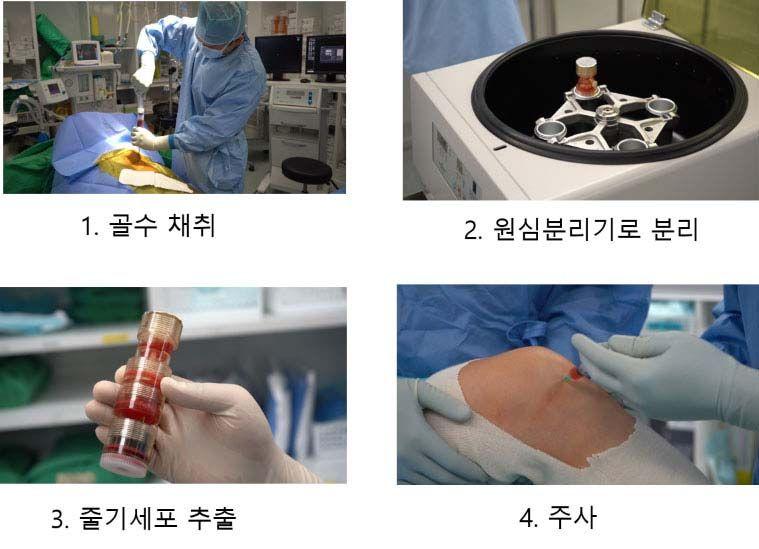
Seoul Yes Hospital announced on the 20th that it has introduced and is currently administering “autologous bone marrow stem cell injection therapy,” a treatment for knee osteoarthritis recognized as a new medical technology by the Ministry of Health and Welfare. It is the first hospital-level medical institution in Yongin City to do so.
The official designation of this treatment, known as autologous bone marrow stem cell injection, as a new medical technology by the Ministry of Health and Welfare is “Intra-articular injection of concentrated bone marrow aspirate for knee osteoarthritis.” The treatment involves aspirating bone marrow fluid from the iliac crest—the part of the patient’s pelvic bone closest to the skin—and then using a centrifuge to separate it into plasma and blood cells. Only the stem cell layer is extracted to create a concentrated solution, which is then injected into the damaged cartilage within the knee joint cavity.
A single injection is expected to provide benefits lasting approximately 1 to 2 years. Since the treatment uses stem cells harvested from the patient’s own body, there is no risk of rejection or genetic mutation. The treatment is expected to alleviate inflammation and pain and improve function in patients with knee osteoarthritis, and it has been certified for safety and efficacy.
The primary candidates for autologous bone marrow stem cell injection therapy are patients with knee osteoarthritis classified as Kellgren-Lawrence (KL) Grade 2 or 3, which corresponds to the moderate stage of the disease. A key feature of this treatment is that it is administered via injection without the need for general anesthesia or incisions, significantly reducing the burden on the patient. The entire process, from bone marrow collection to the injection, can be completed within 30 to 40 minutes, and patients can resume daily activities immediately after the procedure. However, hospitalization for about one day may be required for post-procedure monitoring. Compared to other treatments or procedures for knee osteoarthritis, this method imposes relatively less physical and time-related burden on patients.
Dr. Do Hyun-woo, Director and Chief Orthopedic Surgeon at Seoul Yes Hospital, stated, “In the past, patients with stage 2–3 knee osteoarthritis often experienced slow symptom improvement even with non-surgical treatments; however, autologous bone marrow stem cell injection therapy, whose efficacy has been verified, could serve as a good alternative.” Dr. Do added, “According to a paper published in the Journal of Orthopedic Research, a one-year follow-up study of patients with stage 2–3 osteoarthritis who received this injection therapy confirmed that knee cartilage thickness increased by approximately 10–11%, indicating that significant benefits can be expected.”
Source: https://health.chosun.com/site/data/html_dir/2023/12/20/2023122001812.html