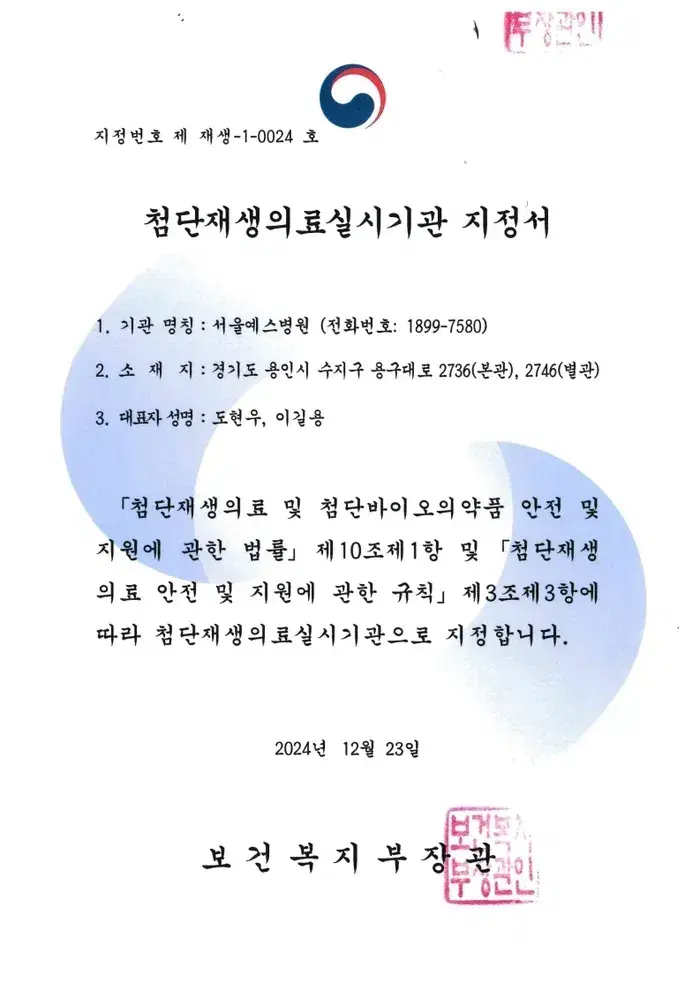
Seoul Yes Hospital designated as an 'Advanced Regenerative Medicine Center'
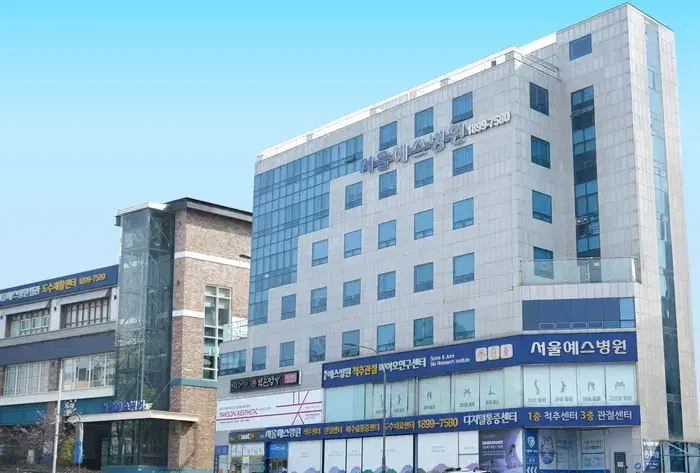
Seoul Yes Hospital (Co-Directors Do Hyun-woo and Lee Gil-yong), located in Yongin Special Self-Governing City, announced that it has recently been designated as an Advanced Regenerative Medicine Implementation Institution approved by the Ministry of Health and Welfare. The Ministry of Health and Welfare accepted applications for Advanced Regenerative Medicine Implementation Institutions for 2024 from April 18 to December 27 of last year. Following the review process, a total of 19 medical institutions were designated as new Advanced Regenerative Medicine Implementation Institutions by the end of 2024. Seoul Yes Hospital was selected as one of these 19 institutions.
Advanced regenerative medicine refers to innovative medical technologies that regenerate damaged human cells, tissues, or organs through stem cell, gene, or tissue engineering therapies to restore normal function. It is a field attracting global attention as it offers new opportunities for treating serious, rare, and intractable diseases that are difficult to treat with existing pharmaceuticals.
An Advanced Regenerative Medicine Implementation Institution is a medical institution authorized to conduct clinical research related to advanced regenerative medicine using human cells, genes, or tissues. Pursuant to Article 10 of the “Advanced Regenerative Bio Act,” such institutions must be designated by the Minister of Health and Welfare. They must meet various requirements, including having the necessary facilities, equipment, personnel, and standard operating procedures for conducting advanced regenerative medicine research. Additionally, key personnel—such as the principal investigator, research coordinators, human cell managers, and information managers—must complete training programs designated by the Minister of Health and Welfare.
Seoul Yes Hospital submitted its application last year and, following procedures such as document verification and on-site inspections, was officially designated as an Advanced Regenerative Medicine Institution on December 23.
Seoul Yes Hospital’s designation as an Advanced Regenerative Medicine Institution is significant as it is the first such designation among hospital-level medical institutions located in Yongin Special Self-Governing City. Furthermore, considering that 83 of the 112 designated medical institutions are tertiary general hospitals and general hospitals, the fact that Seoul Yes Hospital—a hospital-level medical institution—has been designated as an Advanced Regenerative Medicine Implementation Institution can be interpreted as meaning that it possesses research infrastructure and capabilities on par with those of tertiary general hospitals or university hospitals.
Dr. Lee Gil-yong, Director of Seoul Yes Hospital (a board-certified neurosurgeon), stated, “Now that Seoul Yes Hospital has been officially selected as an Advanced Regenerative Medicine Implementation Institution, we will devote ourselves to clinical research that can help treat not only patients suffering from spinal or joint diseases but also those struggling with intractable pain of unknown origin.” “We have already completed preparations for ‘Advanced Regenerative Clinical Research’ involving low- and medium-risk groups, and our goal is to present medical solutions for the treatment of intractable diseases based on the results of these clinical studies,” he added.
Meanwhile, Seoul Yes Hospital received approval from the Ministry of Food and Drug Safety (MFDS) for its in-house cell processing facility in conjunction with its designation as an Advanced Regenerative Medicine Implementation Institution. A cell processing facility is a facility that processes and manipulates human cells or tissues. In accordance with the Advanced Regenerative Medicine Act, it must produce cells used in clinical research in-house and comply with management standards and operational procedures equivalent to those of a Good Manufacturing Practice (GMP) facility for pharmaceuticals. Stem cells cultured through this facility may only be supplied to Advanced Regenerative Medicine Implementation Institutions.